98%lower
6.2 → 0.1 mg/L (after 3 weeks)
Diplomatic building (Washington, DC)
30+ years old · heating hot-water loop
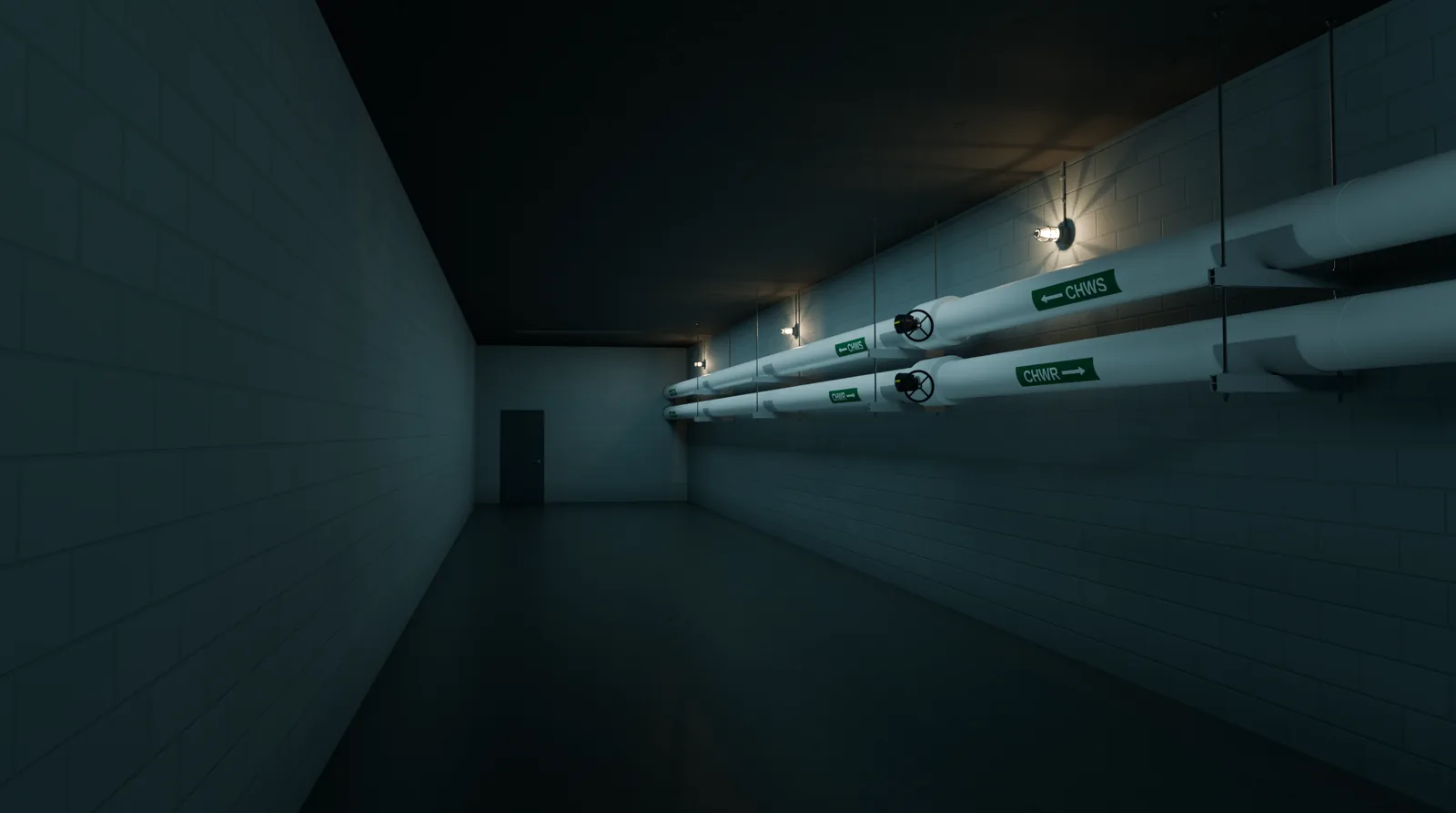
For closed-loop heating and chilled-water mains, 3″ to 20″
Repiping opens walls and ceilings and shuts your system down. NMR Pipetector clamps onto the outside of the main and turns the rust itself into a hard, protective layer.
Try it on one loop. Within 3 months, iron drops to half the starting level or less? You buy the trial unit at the price agreed up front. If not, you don't buy it.
Round 1 trial: heating loops in NJ & NY. Send 2 photos by Nov 30.
Round 1 trialRound 1New Jersey & New YorkCloses November 30, 2026Closes Nov 30Closes in days days leftSee the terms
What are the signs of rust in chilled- and hot-water pipes?
For hotels, offices, hospitals and multifamily buildings more than 30 years old.
NMR Pipetector is built for closed-loop HVAC heating hot-water and chilled-water piping, including loops above 70°C (158°F) and loops with corrosion inhibitors or glycol.*1
How is it installed?
Pick the model for your pipe size, clamp the upper and lower housings around the pipe, and bolt them together. About an hour per unit, with the system running.*3
Fits 3- to 20-inch mains
| Main size | Model |
|---|---|
| 3″ | PT-75DS |
| 4″ | PT-100DS |
| 5″ | PT-125DS |
| 6″ | PT-150DS |
| 8″ | PT-200DS |
| 10″ | PT-250DS |
| Main size | Model |
|---|---|
| 12″ | PT-300DS |
| 14″ | PT-350DS |
| 16″ | PT-400DS |
| 18″ | PT-450DS |
| 20″ | PT-500DS |
We confirm the exact model from your photos or drawings.
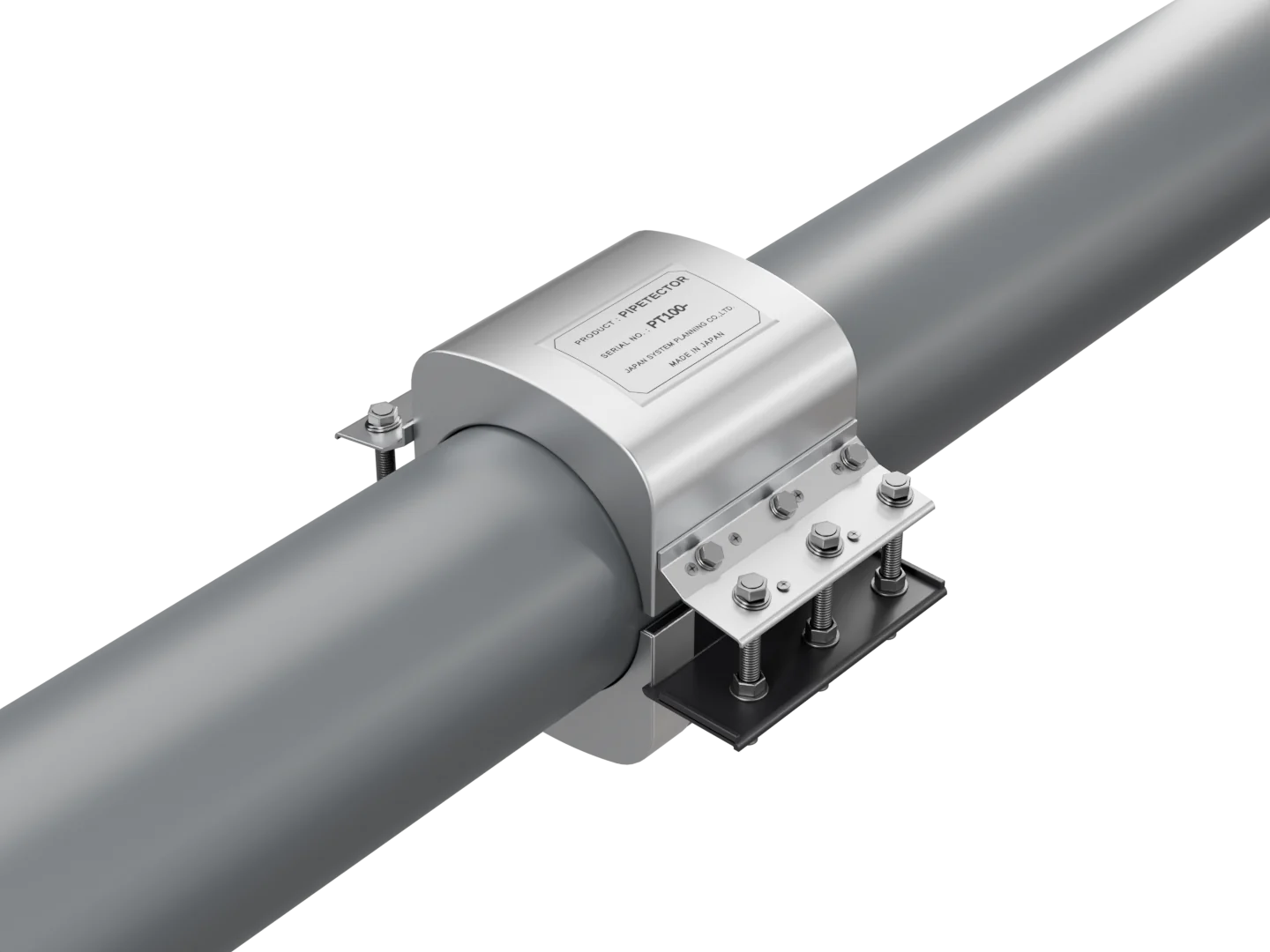
The animation couldn't load. The still images are shown instead.
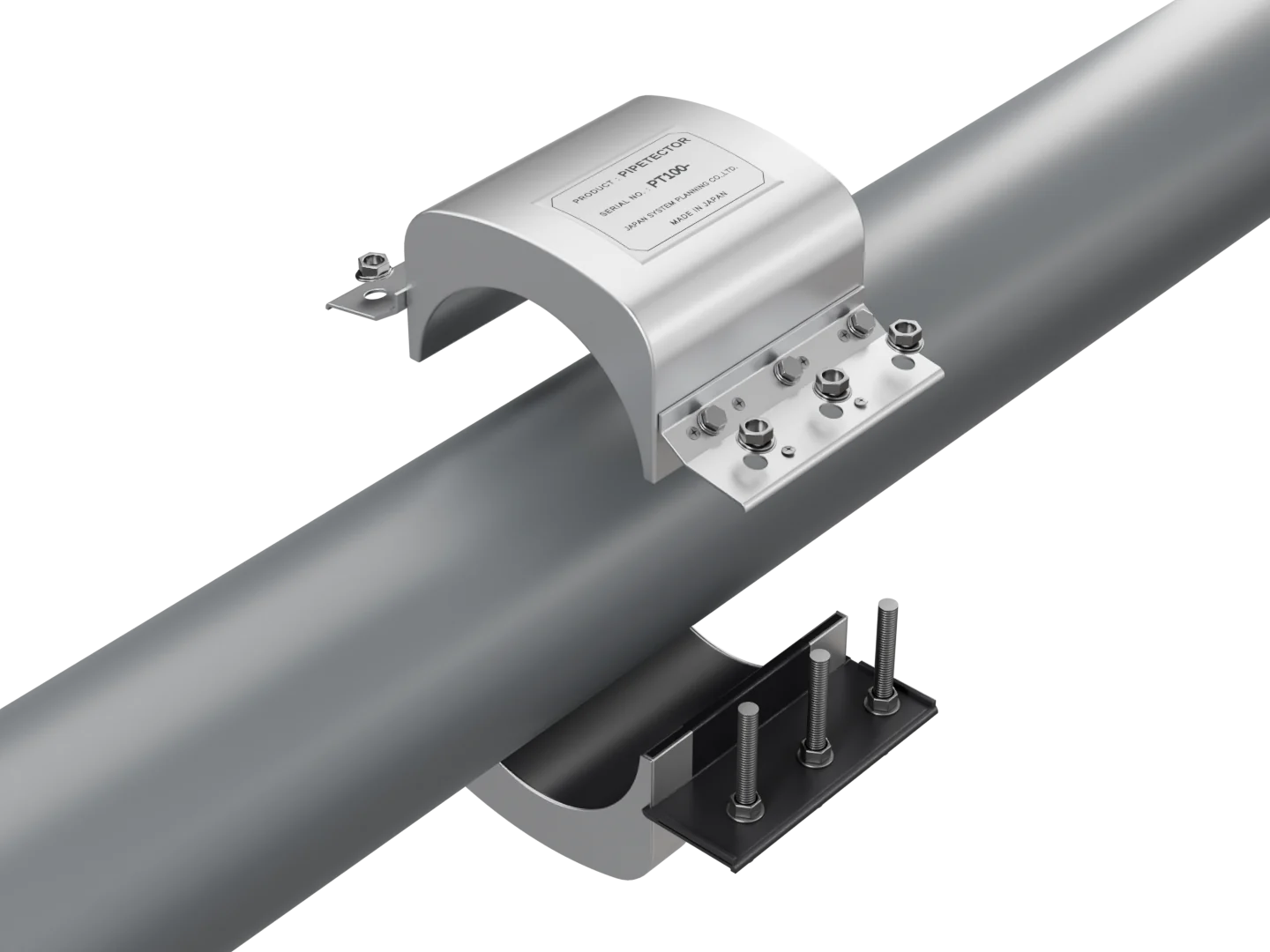
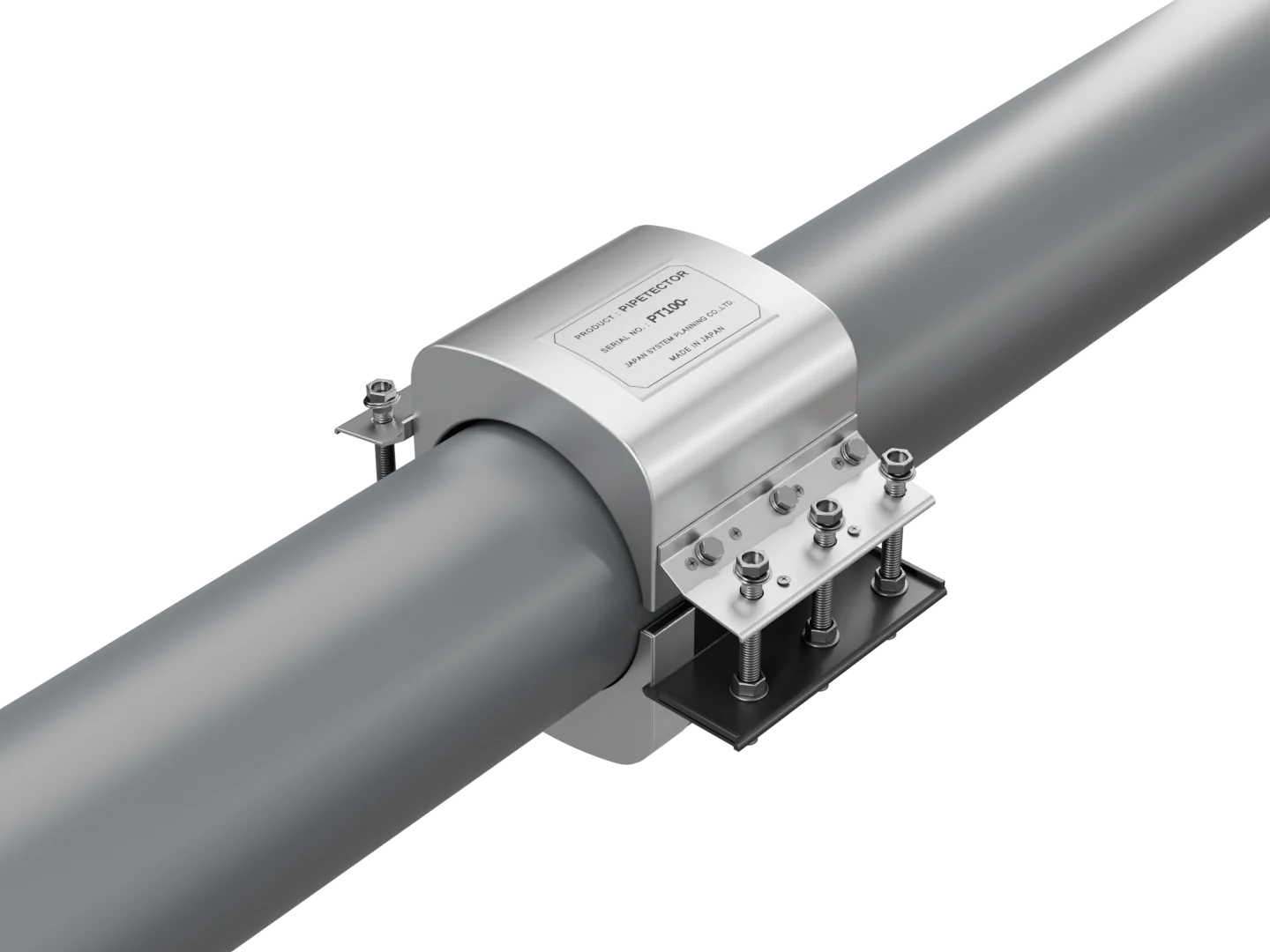
Not scraping the rust off. Not sealing it in. Turning the rust itself into a layer that protects the pipe.
| Item | Repiping | Epoxy pipe lining | Chemical water treatment | NMR Pipetector |
|---|---|---|---|---|
| Method | Open walls and ceilings and replace the pipe | Drain and dry the pipe, then coat the inside with resin | Keep dosing chemicals and managing water quality | Mounts on the outside of the pipe; the device itself uses no power and no chemicals |
| System | Down during the work | Shut down while the lining is applied | Stays in service | Installs without a shutdown |
| The rust | Replaced along with the old pipe | Covered by the coating | Slowed down | Turns into black rust, a protective layer*4 |
| Cost | High | High | Ongoing chemical refills and water testing | Device price, quoted in writing first; buy only if it works; your water treatment continues |
Lost wall thickness doesn't come back, and spots that are already leaking need separate repair.
Loop-water iron, before and after
Five older buildings, from two heating loops in Washington, DC to a chilled-water main at Holiday Inn London Heathrow.*5
98%lower
6.2 → 0.1 mg/L (after 3 weeks)
30+ years old · heating hot-water loop
91%lower
2.3 → 0.2 mg/L (after 3 weeks)
40+ years old · heating hot-water loop
99%lower
0.669 → <0.007 mg/L (after 19 weeks)
Chilled-water main
99%lower
20 → 0.2 mg/L (after 5 weeks)
Heating main
Before and after taken at different points and tested by different labs.
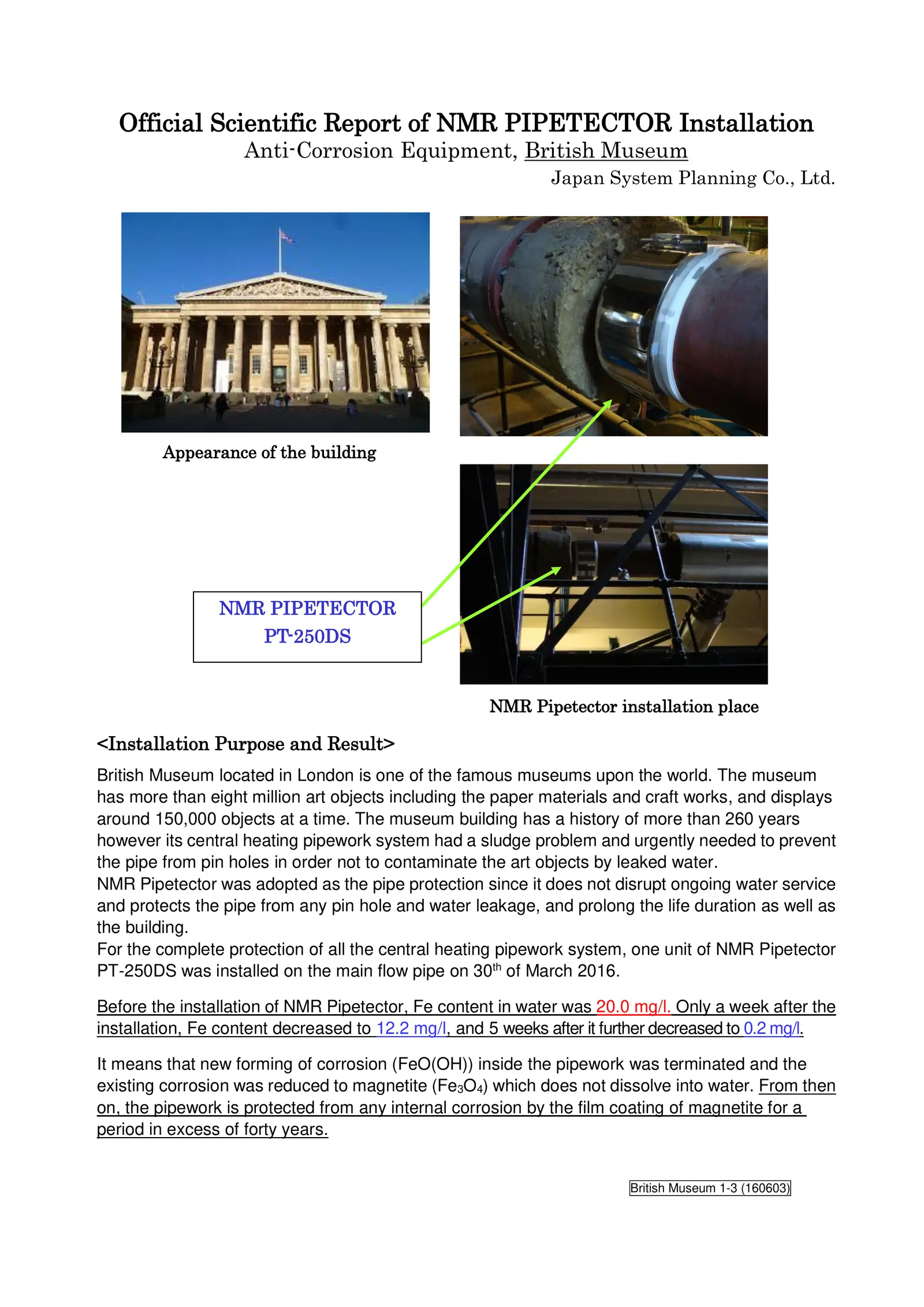
Case report (3 pages)Prepared by Japan System Planning Co., Ltd. · 2016 · Heating main*13
97%lower
1.1 → 0.03 mg/L (after 1 year)
Closed-loop heating (low-temperature hot water)
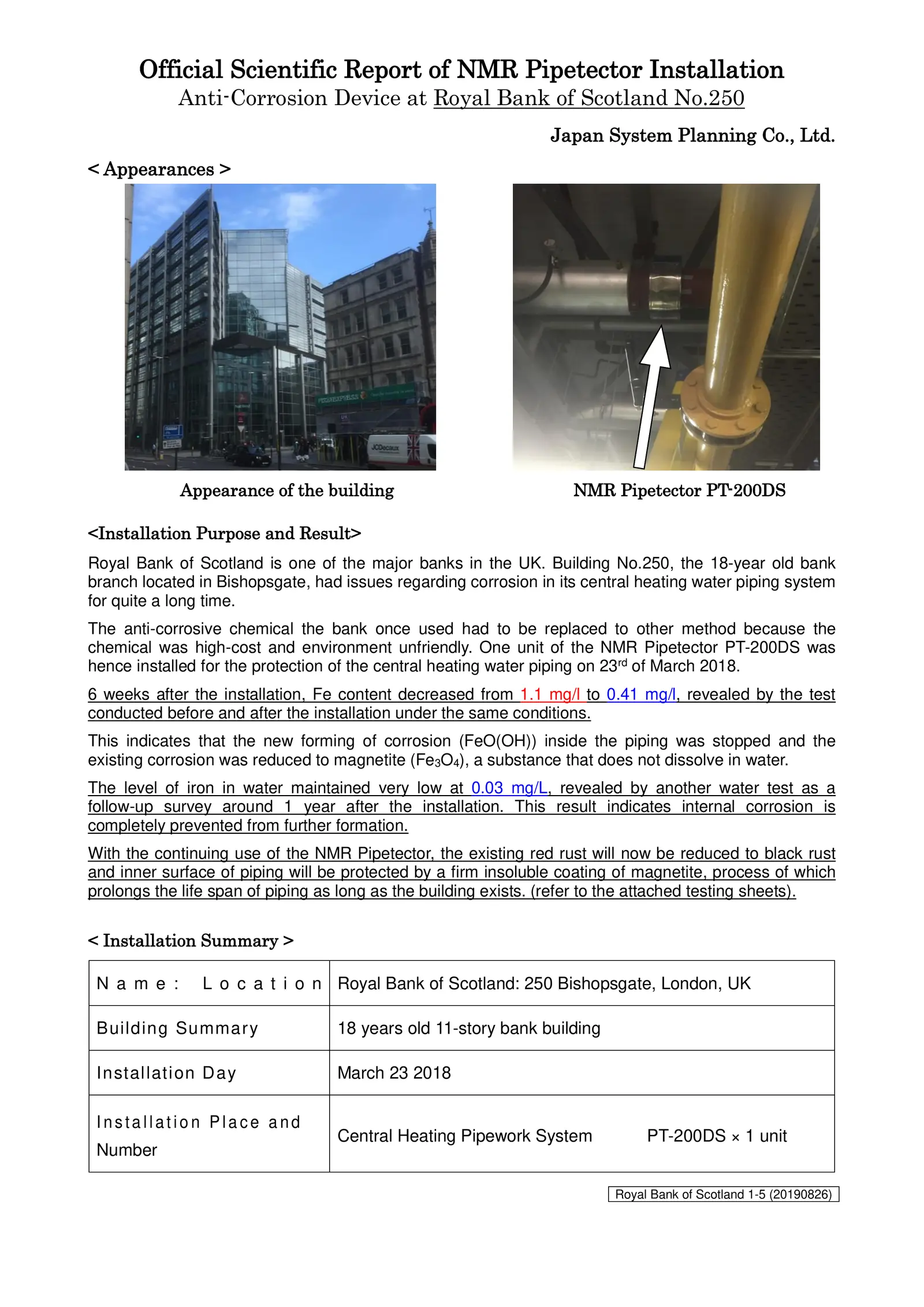
Case report (5 pages)Prepared by Japan System Planning Co., Ltd. · 2019 · Low-temperature hot water (closed loop)*13
In the trial, you measure the same thing in your own building: iron in the loop water, before and after installation, under the same conditions.
Not ready for photos? Email us, and we'll reply with these results and a one-page photo guide within one business day (U.S. Eastern). Privacy note
Building and organization names identify where units were installed. Their mention does not mean those organizations endorse NMR Pipetector or Tengcle; quoted statements are the views of individual staff at the time.
Round 1 trials begin in New Jersey and New York.
Special terms for our Round 1 trial
Before you replace a single pipe, clamp the trial unit onto one of your loops. Your usual lab measures the iron, and the numbers decide.
The unit stays the maker's during the trial. Within 3 months, iron drops to half the starting level or less? You buy the trial unit at the price agreed up front. If not, you don't buy it.*7
Samples come from the same point before and after, and your lab sends its results directly to your building and to us. Your water treatment stays as it is.
Round 1 starts with heating hot-water loops. The trial uses one loop; other loops follow once the effect is confirmed.
An engineer from Japan supervises every Round 1 installation on site. We check the result as soon as iron falls by half. That can be within weeks; 3 months at most.
Closes November 30, 2026Closes in daysNovember 30, 2026, 11:59 p.m. ET
Check if my loop fitsTry it on one loop. Within 3 months, iron drops to half the starting level or less? You buy the trial unit at the price agreed up front. If not, you don't buy it.
Round 1 is now closed. We will announce the next round soon.
Notify me about the next roundWhy turn red rust into black rust?
Red rust eats the pipe. Black rust protects it.
| Property | Red rust | Black rust |
|---|---|---|
| Structure | Porous and flaky. It crumbles off | Dense and hard |
| Behavior | Keeps growing, eating the pipe from the inside | Stops growing and bonds tightly to the wall |
| In water | Dissolves, turning the water red | Does not dissolve |
| For your pipe | Causes pinholes and clogs | Armor that protects the steel |
You already know black rust. It is the blue-black finish a carbon-steel wok takes on when it is first heat-blued, the black-oxide coating on drill bits, and the protective film inside steam boilers, from the locomotive era to today's power plants. NMR Pipetector builds that same protective film on the inside of your pipes.*4
How does red rust turn into black rust?
Iron and the oxygen in the water form red rust, which builds into lumps (tubercles) that narrow the pipe.
The device's electromagnetic waves break large clusters of water molecules into smaller ones.
Electrons hidden inside the clusters are released by the flowing water and reach the red rust.
Red rust that receives electrons becomes a dense, hard film of black rust.*4
Ceramics inside NMR Pipetector emit a specific electromagnetic wave that causes nuclear magnetic resonance (NMR) in the hydrogen nuclei of the water. Water molecules form large hydrogen-bonded clusters. The resonance breaks them into smaller clusters, bringing electrons from the inside to the surface. This state lasts more than 6 hours.
Red rust forms: 4Fe + 3O₂ + 2H₂O → 4FeO(OH)
Red rust becomes black rust: 6FeO(OH) + 2e⁻ → 2Fe₃O₄ + 2H₂O + 2OH⁻
Red rust, FeO(OH), is a brittle, layered crystal that dissolves into the water. Black rust, magnetite (Fe₃O₄), is a dense spinel-type crystal. It takes up roughly one-tenth the volume, bonds tightly to the pipe wall, and does not dissolve in water.*4
How widely is it used?
The maker's track record, mostly in Japan and the U.K.
30+ years
In use in Japan since the mid-1990s*2
4,400+
Installations in Japan, the U.K. and other countries*2
40+ years
Expected life of the device (no power, no maintenance)*1
10 years
Maker's product warranty*6
Patented in Japan and the United States.*6
When we came across this technology in Japan, we were amazed. Everyone assumes an aging building's pipes will eventually have to be replaced. Yet in Japan, a device that takes on rust from outside the pipe had been in use for more than 30 years. Tengcle Development LLC brings NMR Pipetector to buildings across the United States. We learn how your building and piping work, confirm the fit before anything is signed, and stay with you, alongside the engineers from Japan, all the way through the trial installation.
Tengcle Development LLC is your US point of contact from the photo pre-check to the final result, for scheduling and all follow-up. Japan System Planning Co., Ltd. holds the contract and the product warranty.
It mounts on iron and steel pipe, including black steel and galvanized steel pipe, and on copper pipe. Models range from about 1 to 80 inches (25 mm to 2,000 mm); for the Round 1 trial we focus on the 3- to 20-inch mains common in commercial buildings.*8 This page covers closed-loop chilled-water and heating hot-water piping. It is not for steam lines. In multifamily buildings, it fits those with a central plant circulating hot or chilled water.
Yes. On loops above 70°C (158°F), insulation is wrapped around the pipe where the unit is mounted. Corrosion inhibitors and glycol in the water are no problem.*1
One for each circulating loop (each chilled-water or heating hot-water system), mounted on that loop's main pipe. One unit covers about 2 km (about 6,500 ft) of piping in that loop. So the number of units depends on how many loops you have, and the model on the size of the main. If a loop has more piping than that, we may ask for drawings to confirm the count. If water in a steel main flows faster than 2 m/s (about 6.56 ft/s), two units are installed in series. The mounting point needs at least 130 mm (about 5 inches) of straight pipe.*1 We confirm the number of units and the model from your photos.
Round 1 starts with heating hot-water loops. The trial uses one loop; other loops follow once the effect is confirmed.
The model depends on the size of the main, and the number of units on how many loops you have. An inquiry commits you to nothing: after a quick photo pre-check, if NMR Pipetector fits, you receive a written price for your building and a draft trial agreement for your owner or board, and nothing is signed until they approve. Try it on one loop. Within 3 months, iron drops to half the starting level or less? You buy the trial unit at the price agreed up front. If not, you don't buy it.*7
Your building engineers, the people who maintain your piping, or a licensed local mechanical contractor install it, with an engineer from Japan supervising on site. The licenses required vary by state and building, so we confirm them in advance. In Hawaii and Washington, DC, engineers from Japan did the installation.*8
No. The upper and lower housings clamp around the outside of the pipe and bolt together. Each unit takes about an hour.*3 If the insulation at the mounting point has to be opened, older buildings need an asbestos survey first, and a licensed contractor removes and restores the insulation. Sometimes the unit can go on a bare section of pipe.
No. Lost wall thickness doesn't come back, and any spots that are already leaking need separate repair. From here on, it turns the red rust that forms into black rust, which doesn't dissolve into the water.*4
We compare iron in water sampled at the same point before and after installation. Trial samples, collected in our presence, are tested by your usual lab, which sends its results directly to your building and to us. The trial is a success when iron is half the pre-installation level or lower, within 3 months.*7 The full rules, including how the pre-installation level is set, are under How the trial is judged.
Black water often contains fine particles of black rust (magnetite). Black rust is more stable than red rust, so black water is not necessarily an immediate danger. As the particles build up, though, they can clog strainers and heat exchangers and reduce flow. If reddish-brown water appears or iron keeps rising, corrosion may be progressing, and we recommend checking it with a water test. Read the full guide
There is no single standard, and guidelines vary by source. For example, one water treatment company's guideline is below 1 ppm (mg/L), and one university's facility specification sets a limit of less than 2 ppm. What matters most is whether iron is higher than in the makeup water, and whether it keeps rising. This trial judges the result against your building's records or the pre-installation level.
Yes. Copper and stainless steel resist rust themselves, but the steel fittings and valves connected to them can still rust, and that rust can start corrosion where it settles on other metals. NMR Pipetector works on the water in the loop and turns the red rust in it into black rust.*1
It works as long as some water flows through the pipe where it is mounted every day. In a closed loop, water circulates whenever the pump runs, so a loop with little makeup water can still be part of the trial. The guideline is at least 8 hours a day and 6 months a year of operation.*1 Loops that stay off for long periods, such as heating in summer, are tested while they are running.
No. NMR Pipetector works with electromagnetic waves: ceramics inside the unit emit them, and a component made of magnets concentrates them and sends them into the pipe. It does not treat water with magnetism.*4 The case-study results above were measured as iron in the water before and after installation, and your trial is judged the same way.
Your trial is decided by your own building's numbers: we compare the average of your usual lab's three most recent results after installation with the pre-installation level. If iron doesn't fall to half or lower, you don't buy the unit. The figures in the case studies were measured at the installation sites; in the UK and elsewhere, analytical laboratories ran the tests. No trial has yet compared a loop with the unit side by side against one without it.
Yes. Flushing, filtration, changes to water treatment and seasonal changes in operation can all change iron levels. That's why we ask you to keep your current water treatment unchanged during the trial, and we judge the result on the average of the three most recent results, not on a single sample. If you flush, repair or do other work that could affect iron levels, please let us know.
Neither.*1 It works as long as some water flows through the pipe every day.
Yes. Keep your treatment program unchanged during the trial so the before-and-after numbers compare fairly. We share the results with your water treatment provider.
No flushing or draining is needed for the trial. During the trial, please keep your current water treatment unchanged, so that the before-and-after comparison is made under the same conditions. If the system needs flushing or repairs, those come first; please let us know.
Send us two photos of one heating loop: the circulation pump with its main pipe, and any size marking or insulation label. Once both photos arrive, we reply within 2 business days. We tell you if NMR Pipetector fits and which model. If something still needs checking, we say what and when we'll update you. If it fits, you get a written price for your owner or board to approve. Nothing is signed until they do.
Tengcle Development LLC is your US point of contact. Japan System Planning Co., Ltd. holds the contract and the product warranty.
Email us at pipetector@tengcle.com
What happens to what you send us: privacy note
Try it on one loop. Within 3 months, iron drops to half the starting level or less? You buy the trial unit at the price agreed up front. If not, you don't buy it.