Red or black water in your chilled or hot water loop: causes, and what to check first
Prepared by Tengcle Co., Ltd. (Japan)
You opened a strainer and found black sludge. Your latest water report shows iron higher than last time. Either one can mean iron is dissolving from the inside of your pipes.
This guide walks through what the color tells you, what to check first, when a number is worth acting on, why rust keeps forming in a closed loop, and your options.
1. What the color tells you
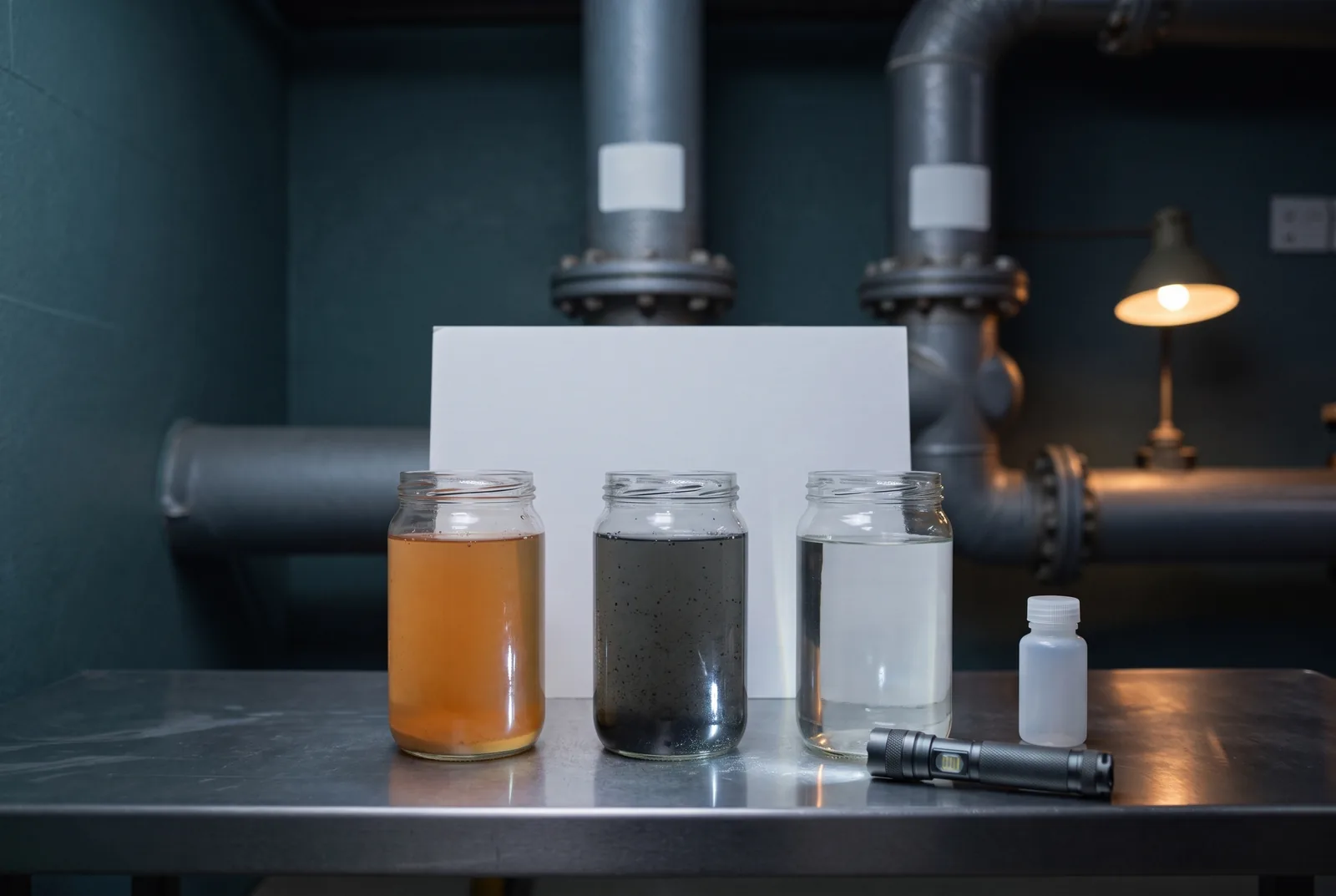
- Reddish-brown: particles of red rust (iron oxyhydroxide, FeO(OH)). It shows up when oxygen gets into the loop and iron dissolves from the pipe. Red rust is brittle; it flakes off and travels with the water.
- Black: often fine particles of black rust (magnetite, Fe₃O₄), though color alone can't confirm it (iron sulfide is black too). Black rust is more stable than red rust, so black water is not automatically an emergency. But as the particles build up, they clog strainers and heat exchangers.
- Clear isn't proof: dissolved (ferrous) iron is often invisible and can turn reddish-brown only after it oxidizes, for example once the sample meets air. Don't judge by eye; confirm with lab numbers.
2. What to check first
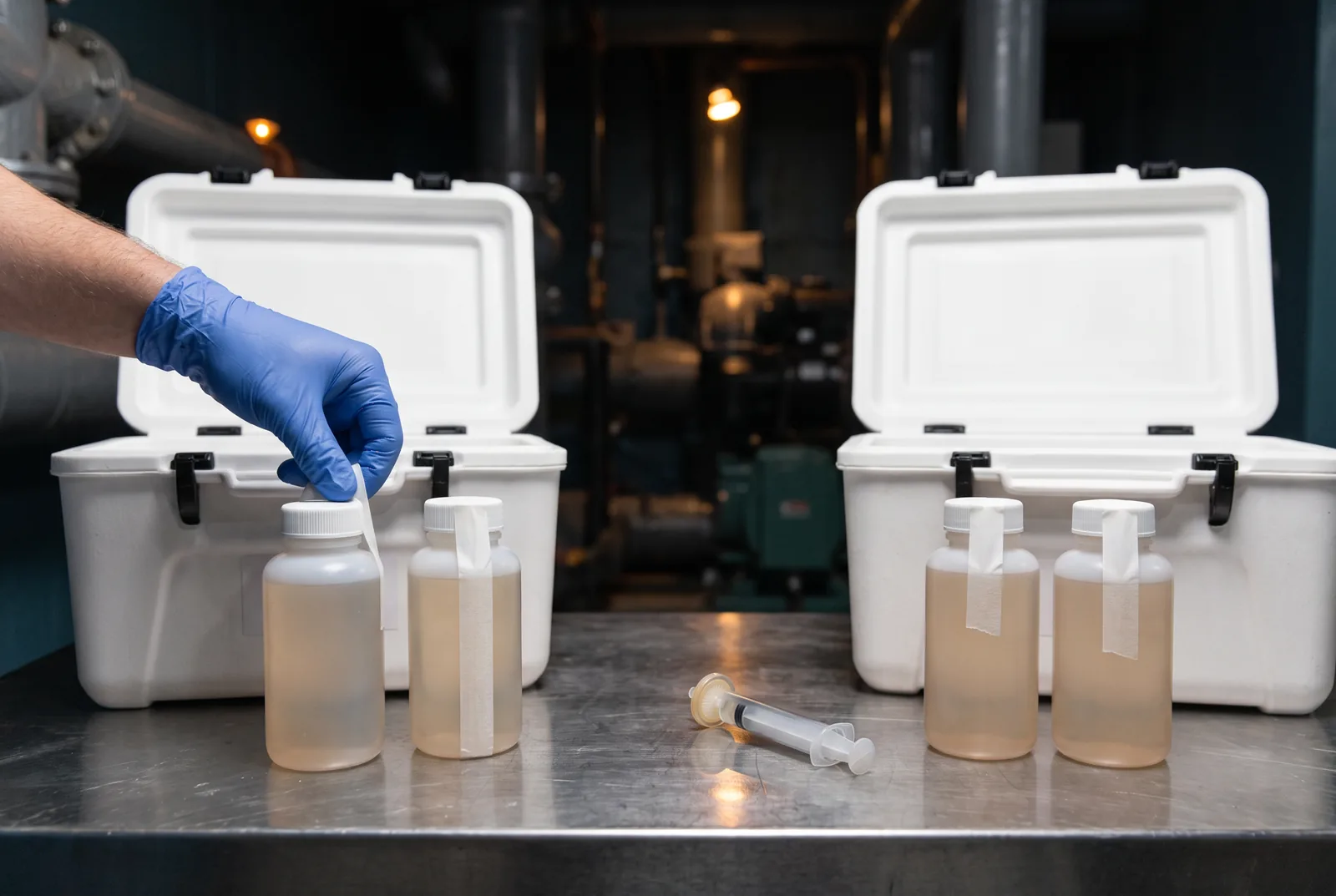
- Sample the same way, at the same point. Pick a point that represents the circulating water, and flush it the same way each time with the loop running. A low-point drain is common,*3 but its first water carries settled sludge. If the point or the routine changes, the numbers can't be compared.
- Measure total iron and dissolved iron separately. Rust particles and dissolved iron call for different fixes. Ask the lab how to collect and preserve each sample, and keep the method the same every time.
- Test the makeup water too. If the loop is higher than the makeup water, iron is being released inside the loop,*2 either from active corrosion or from old rust and mill scale. The trend and the corrosion checks below tell you which.
- Check pH, inhibitor level and makeup volume. They point to the cause: low pH, low inhibitor, or a loop that keeps taking on fresh water.
- Check corrosion rate and wall thickness. Corrosion coupons show metal loss over the time they are installed, and repeated ultrasonic thickness readings at the same spots show wall loss over time.*2
3. How much iron is too much?
There is no single standard, and guidelines vary by source.
| Source | Iron guideline for a closed loop |
|---|---|
| ChemREADY, a water treatment company*3 | Under 1 ppm (mg/L), listed as "Iron (dissolved + total)" |
| Dartmouth College's facility design guideline (2024)*4 | Under 2 ppm, in its minimum water quality for closed hot and chilled water systems |
| A U.S. National Institutes of Health (NIH) technical bulletin (2025)*2 | Gives no numeric iron limit: compare with the makeup water and watch the trend |
Read the number together with whether iron is higher than in your makeup water and whether it keeps rising. Iron alone can't tell you the condition of the pipe. Where your equipment maker or water treatment provider sets limits, follow those first.
4. Why rust keeps forming in a closed loop
A closed loop circulates the same water. Once the oxygen inside is used up, corrosion slows. When rust keeps appearing, one of these is usually going on.*1, *2
- Oxygen keeps getting in: with makeup water (and leaks mean more makeup), as air drawn in wherever the loop runs under negative pressure, through expansion tanks open to air, and through plastic pipe without an oxygen barrier. Every time you drain and refill, fresh oxygen comes in.
- Corrosion inhibitor is low or depleted: inhibitors are diluted by leaks and makeup water and used up by reactions and microbes, and spots where water sits still lose protection.
- pH has dropped: degrading glycol forms acids that lower pH.
- Microbes, sludge deposits and dead legs: they cause localized corrosion.
- Iron that isn't from corrosion: iron in the makeup water, or mill scale from new pipe, can raise iron without corrosion in your loop.
5. What happens if you leave it
Rust particles collect in strainers, heat exchangers and air handler coils, cutting flow and heat transfer, so heating and cooling get weaker. In systems that speed up the pumps to hold flow, energy use rises too. Where corrosion concentrates in one spot, it can eat a pinhole through the pipe and start a leak.
6. Your options
| Option | When to consider it | Keep in mind |
|---|---|---|
| Find and fix the oxygen source | Makeup volume keeps rising, pressure runs low, or air gets in | Check for leaks, excess makeup, low pressurization and air ingress. Comes first; the options below work better once it's done |
| Correct pH and inhibitor levels*2 | Inhibitor level or pH is low | Analyze the water, then adjust pH and top up or change the inhibitor; ongoing testing and dosing |
| Clean and refill | Deposits and sludge keep building up | Removes deposits: clean with a cleaning agent, flush, then add inhibitor. Draining lets fresh oxygen in |
| Filtration / magnetic separation | Particles keep collecting in strainers and heat exchangers | Passes part of the flow through a filter or separator to catch particles; magnetic separators work well on magnetite; doesn't remove dissolved iron; connection work depends on your existing setup; needs periodic cleaning |
| Replace sections or repipe | Thickness readings or leaks show damaged pipe | Cost and downtime depend on the scope |
These are often combined.
7. Check if one of your loops fits the trial
We bring NMR Pipetector to U.S. buildings: a Japanese device, used for more than 30 years, that clamps onto the outside of the pipe and turns red rust into a hard, protective layer of black rust. No cutting into the pipe, no shutdown, no chemicals, no power.*5 Your existing water treatment and maintenance continue during the trial. See iron measured before and after installation in closed-loop heating and chilled-water systems, with the documents, in the results on our main page.
Test it in your own pipes, with your own lab. Water is sampled at the same point before and after installation, and iron is measured by the lab your facility already uses. Try it on one loop. The unit stays the maker's during the trial. Within 3 months, iron drops to half the starting level or less? You buy the unit at the price agreed in writing before the trial. If not, you don't buy it. Pipe that is leaking or too thin is repaired first.
Round 1 of the trial is for buildings in New Jersey and New York and starts with heating hot-water loops. If yours is a chilled-water loop or in another state, check it now anyway. We'll still reply and keep you posted on future rounds.
From two photos of the area around the pump, we can quickly check whether the unit can be installed.
See the trial terms. If the button doesn't work, write to pipetector@tengcle.com with your state, the piping system (heating hot water or chilled water), what you're seeing (water color, strainer sludge, iron test results) and your water treatment provider, and attach 2 photos of the loop: the circulation pump with the main pipe next to it, and a close-up of any size marking or insulation label.